
What are garage door safety sensors?
Garage door safety sensors are one of the most important safety features built into modern garage door systems. They exist for one reason, to prevent accidents when the door is closing.
Because garage doors are extremely heavy, even a slow-moving door can cause serious injury or damage if something is in its path. Safety sensors act as a safeguard, stopping that from happening.
Today, they are not optional. They’ve been a required part of automatic garage door systems since the early 1990s, and for good reason.
How Garage Door Safety Sensors Actually Work
Most modern garage doors use photoelectric sensors.
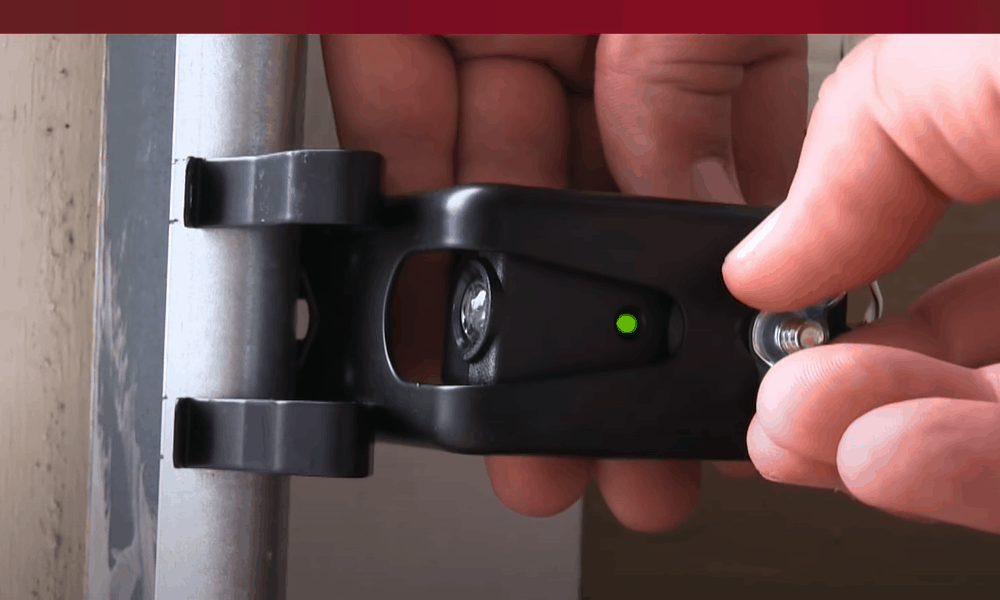
These sensors are mounted near the bottom of the door tracks, typically on both sides. One sensor sends out an invisible infrared beam, while the other receives it. As long as that beam remains uninterrupted, the system allows the door to close normally.
The moment something crosses that path, whether it’s a person, a pet, or even a small object, the beam is broken. When that happens, the door immediately stops and reverses direction.
The process happens instantly. There’s no delay, and no need for manual input.
Why Safety Sensors Are Essential for Your Garage
Garage doors didn’t always include this level of protection. Before sensors became standard, accidents were far more common because doors would continue closing regardless of what was underneath them.
Today, sensors change that completely.
They provide a constant check between open space and obstruction, reducing the risk of injury and preventing damage to vehicles, equipment, or anything stored in the garage. For households with children or pets, this feature is especially important.
In practical terms, safety sensors are what make automatic garage doors safe for everyday use.
What Happens When Sensors Start Malfunctioning
Like any component, sensors can develop issues over time. The difference is that when sensors fail, the problem is often immediately noticeable.
A door may refuse to close, stop midway, or reverse unexpectedly. In some cases, it may behave inconsistently, working one moment and failing the next.
These issues are not random. They usually point to one of a few underlying causes.
| Issue Type | What’s Happening | Likely Cause |
| Door won’t close | Sensor beam is blocked or disrupted | Dirty lens or obstruction |
| Door reverses | Signal interruption during closing | Misalignment |
| Inconsistent use | Intermittent signal loss | Wiring issue |
Understanding the cause helps determine whether it’s a simple fix or something that requires professional attention.
The Most Common Reasons Sensors Fail
In many cases, sensor problems are not due to major damage, but to small issues that affect performance.
Dust and dirt can accumulate on the sensor lens over time, interfering with the infrared beam. Even a thin layer of debris can reduce accuracy.
Wiring is another common factor. Since sensors rely on a steady electrical connection, loose or damaged wires can interrupt the signal and cause inconsistent operation.
Alignment also plays a critical role. The sensors must face each other directly. If one shifts slightly out of position, the beam is broken, even if nothing is physically in the way.
These issues are simple in concept, but they require careful handling to fix properly.
How to Tell If Your Sensors Are Out of Alignment
One of the easiest ways to detect a problem is by looking at the indicator lights on the sensors.
When properly aligned, the lights remain steady. If they begin blinking, it usually means the sensors are no longer lined up correctly.
This misalignment can cause the door to behave as if there’s an obstruction when there isn’t, or worse, fail to detect a real obstruction.
Even a small shift can disrupt the system.
Testing Your Garage Door Safety Sensors
If you suspect your sensors are not working correctly, a simple test can help confirm it.
Place an object, such as a box, directly in the path between the sensors and attempt to close the door. If the sensors are functioning properly, the door should stop and reverse as soon as the beam is interrupted.
If the door continues closing, that’s a clear sign the sensors are not doing their job.
At that point, the issue should be addressed before using the door again regularly.
When It’s Time to Call a Professional
While some issues, like cleaning the lens or minor alignment adjustments, may seem straightforward, not all sensor problems are easy to diagnose.
Electrical issues, damaged wiring, or persistent misalignment often require more than a quick fix. Attempting to troubleshoot without proper knowledge can lead to further problems or leave the system in an unsafe condition.
A professional technician can quickly determine whether the issue is with the sensors themselves or another part of the system affecting their performance.
Professional Garage Door Sensor Repair in Killeen
At Premier Overhead Co., safety sensor issues are handled with a full-system approach. Our technicians ensure that sensors are properly aligned, clean, and fully integrated with the rest of the garage door system.
If your door is not closing properly, reversing unexpectedly, or behaving inconsistently, it’s worth having the sensors inspected before the issue becomes a safety concern.
Contact us today for expert garage door sensor repair in Killeen.
A Final Thought on Garage Door Safety
Garage door safety sensors are easy to overlook because they work quietly in the background. But they play a critical role every time the door closes.
When they’re working properly, you don’t notice them. When they’re not, the entire system becomes unreliable.
Making sure they stay clean, aligned, and functional isn’t just maintenance, it’s protection for everything and everyone in your garage.